Based on reported import licenses, US long steel products imports fell 37% from 427,000 short tons in April 2018 to 270,000 in April 2019. The drop was mainly due to lower rebar and parallel flange sections imports. However, wire rod import licenses in April 2019 were 38% higher than April 2018 imports, offsetting declines in other product categories.
Based on January to March imports and April import licenses, long products imports in the first four month of 2019 were 11% lower than in the same period last year, with imports of all products categories declining except for wire rod, which rose 10%.
Based on reported import licenses, US flat steel products imports rose 8% from 622,000 short tons in February to 671,000 tons in March. Compared to March import licenses, April licenses rose 4% to 696,000 tons, mainly due to higher hot roll licenses from Japan and higher cut plate licenses from South Korea.
Based on January/February imports and March/April import licenses, flat products imports so far this year are 20% lower than in the first four months of 2018, with imports of hot roll down 23%, hot dip galvanized down 17%, cold roll down 23%, and cut plate up 2%.
Worldsteel reported crude steel production in China at 80.3 million metric tonnes in March, 10.0% higher than in March 2018. Chinese output over the first three months of 2019 was 9.5% higher than in the same period last year.
China’s General Administration of Customs reported Chinese net finished steel exports (exports minus imports) in March at 5.4 million tonnes, 22.8% higher than in March 2018. Net exports in the first three months of 2019 were 20.8% higher than in the first three months of 2018.
China monthly crude steel production 2006 to 2019
thousand metric tonnes
Photo of the Harbin Grand Theatre by Jeremy Thompson from Los Angeles, California [CC BY 2.0 (https://creativecommons.org/licenses/by/2.0)]
China accounted for 52% of world output in March with production of 80.3 million tonnes, 10.0% higher than in March 2018. Asian output outside of China remained steady, rising 0.8% March-on-March, though a 48.9% rise in Vietnam was offset by declines in Thailand, Pakistan, and India.
European Union production fell 1.2% between March 2018 and March 2019, with Belgian output down a significant 25%. In other parts of Europe and the Middle East, Turkish production fell (-11.7%), as did Russian production (-6.9%), but Ukraine output rose (+15.0%). In North America, US production rose 5.7%, Canadian production was up 3.4%, but Mexican output fell 3.8%. In addition, Iranian crude steel production rose 19.7% year-on-year.
Photo of Houston skyline by Henry Han [CC BY-SA 3.0 (https://creativecommons.org/licenses/by-sa/3.0)]
Based on reported import licenses, US long steel products imports fell 52% from 367,000 short tons in January to 175,000 tons in February. Compared to February import licenses, March licenses rose 73% to 302,000 tons. The 73% rise was mainly due to higher rebar import licenses for countries including Portugal and Spain, as well higher parallel flange sections import licenses from Luxembourg and Taiwan.
Based on January imports and February/March import licenses, long products imports so far this year are 3% lower than in the first quarter of 2018.
SIMA US long products import licenses
January 2013 to March 2019
short tons
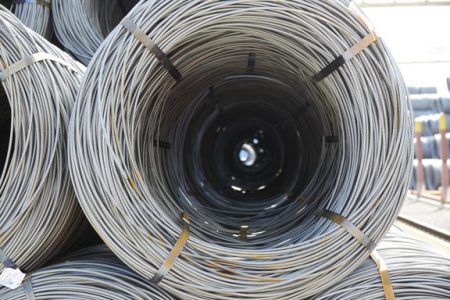
A single wire rod coil in storage at Kehl am Rhein, Germany Photo from Worldsteel Image Library by worldsteel / Gregor Schlaeger, Image ID 537
In its latest Short Range Outlook (SRO), published yesterday, Worldsteel revised its world apparent steel use (ASU) growth forecast for 2019 downward. The revision lowered estimated demand growth between 2018 and 2019 from 1.4% in its October 2018 SRO to 1.3% in yesterday’s figures.
China accounted for 49% of world steel demand in 2018 and while China’s ASU was expected to grow by 6% in 2018, demand actually grew by 7.9% (after adjusting for demand supplied by outdated induction furnaces closed during 2017, real demand growth was 2.0%). China’s steel demand is now forecast to grow by 1% in 2019 and by -1% in 2020.
For the world outside of China, ASU grew marginally higher than expected in 2018, by 2.2% instead of the forecast 2.1%. However, the new forecast revises 2019 demand outside of China down from 2.7% to 1.7% with revised lower demand in the EU, Other Europe, Central & South America, Africa and the Middle East.
Photo of Guangzhou Opera House by Mr a [CC BY 3.0 (https://creativecommons.org/licenses/by/3.0)]