Based on reported import licenses, US long steel products imports fell 6% from 226,000 short tons in September to 213,000 tons in October. The decline is mainly the result of lower parallel flange sections imports from Luxembourg and lower rebar imports from Turkey.
Based on January-to-September imports and October licenses, long products imports in the first ten months of 2018 were 27% lower than in the same period last year with the largest volume declines coming from wire rod, down 31%, and rebar, down 21%.
SIMA US long products imports licenses
2012 to 2018
short tons

Photo of rebar on column of the eastern span rebuild of the San Francisco-Oakland Bay Bridge by Leonard G. – Own work, CC0, https://commons.wikimedia.org/w/index.php?curid=15223591
Based on reported import licenses, US flat steel products imports are expected to rise 2% from 837,000 short tons in September to 856,000 tons in October. This is due to higher expected hot dip galvanized imports from countries including the United Arab Emirates and Turkey, as well as higher cut plate imports from South Korea.
Based on January-to-September imports and October import licenses, flat products imports in the first ten months of 2018 were 6% lower than in the same period last year with a rise in hot roll imports (+19%) offsetting a decline in cold roll (-26%), hot dip galvanized (-12%), and cut plate (-22%) imports.
SIMA US flat products imports licenses
January 2013 to October 2018
short tons
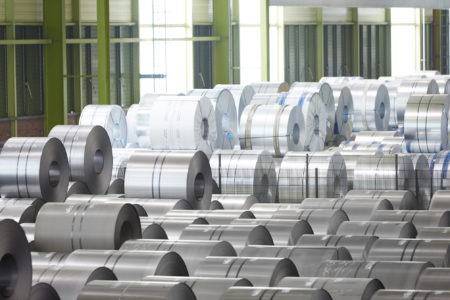
Steel coils in storage in the hot-dip coating line, designed by Friedrich Ernst von Garnier, Duisburg, Germany
Photo from Worldsteel Association Image Library by worldsteel / Gregor Schläger, Image ID: 180
US mills have started reporting Q3 2018 earnings and in most cases EBITDA per ton shipped is higher than in Q2. One exception was CMC, whose EBITDA per ton dropped from $89 to $84. The other mills all reported higher EBITDA per ton: AK $119 to $131, Nucor $171 to $196, SSAB $144 to $158, SDI $213 to $222, TimkenSteel $83 to $84. We’ll keep you posted as more mills report.
Worldsteel reported Chinese crude steel production at 80.8 million metric tonnes, 7.5% higher than in September 2017. Chinese output over the first nine months of 2018 was 6.1% higher than in the same period last year.
Chinese net finished steel exports (exports minus imports) in September were approximately 4.9 million tonnes, 24% higher than in September 2017. Net exports in the first nine months of 2018 were about 13% lower than in the first nine months of 2017.
China monthly crude steel production
January 2006 to September 2018, thousand metric tonnes
 Maglev train at Pudong International Airport, Shanghai
Photo by user Alex Needham (own photography) on en.wikipedia [Public domain], via Wikimedia Commons
Worldsteel published September’s world crude steel production on October 24th. World steel output was 151.7 million metric tonnes, 4.4% higher than in September 2017. Crude steel production in the first nine months of 2018 was 4.7% higher than in the same period last year.
China accounted for 53% of world output in September with production of 80.8 million tonnes, 7.5% higher than in September 2017. Asian output outside of China grew 1.4% with increases in India (+2.1%) and Vietnam (+54.5%) offset by declines in Japan (-2.4%) and South Korea (-3.4%). European Union output was flat, increasing 0.2%, with higher output in Germany (+7.5%), the Czech Republic (+59.2%) and Belgium (+16.2%) offsetting declines in Austria (-45.5%) and Sweden (-38.3%). US production was up 9.0% compared to last September, while neighboring Mexico increased production by 0.2% and Canada lowered output by 2.0%. Other notable changes year-on-year include a 5.9% drop in Turkey and a 7.6% decline in Ukraine.
 Coal barge transport next to The Point facing Pittsburgh’s West End Bridge
Photo by James Moss
Based on reported import licenses, US long steel products imports are expected to fall 35% from 333,000 short tons in August to 216,000 tons in September. This is mainly the result of lower rebar and wire rod import licenses. Rebar license volumes dropped 60% compared to August actuals due to lower licenses for Turkey, Italy, and Spain, and wire rod licenses dropped 25% compared to August actuals, principally for Turkey.
Based on January-to-August imports and September import licenses, long products imports in the first nine months of 2018 were 27% lower than in the same period last year, led by a 31% fall in wire rod imports and a 22% drop in rebar imports.
SIMA US long products import licenses
2012 to 2018
short tons
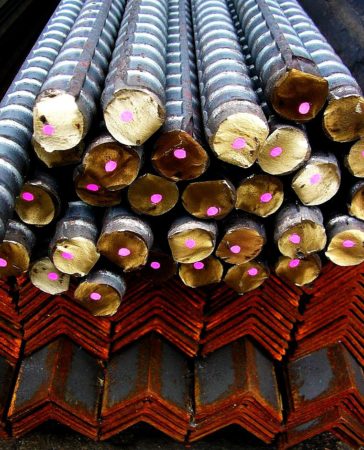
Photo by Flickr.com user “tanakawho” [CC BY 2.0 (https://creativecommons.org/licenses/by/2.0)], via Wikimedia Commons


