In celebration of the Italian Republic Day holiday (& steel) tomorrow, we’re sharing our profile of the Italian steel industry. Just click on the flag below to read & download the PDF report.
This fine looking profile was engineered in our Steel Data Room. The underlying data will automatically update. So we won’t have to do anything for next year’s celebration, except point you to the new one.
You can register for a free Steel Data Room trial to access the original dynamic Italian Steel Industry dashboard, where you can choose to make the report about your own country or region simply by making a selection in the dropdown box. Celebrate Tonga on June 4, Denmark on June 5, Sweden on June 6, Russia on June 12, Djibouti on June 27…. There’s no end to celebrating global steel production. Auguri Italia!

Worldsteel reported Chinese crude steel production at 76.7 million metric tonnes in April, 4.8% higher than in April 2017. Chinese output over the first four months of 2018 was 5.2% higher than in the same period last year.
Chinese net finished steel exports (exports minus imports) in April were 5.4 million tonnes, 0.4% higher than in April 2017. Net exports in the first four months of 2018 were 24.3% lower than in the the first four months of 2017.
China monthly crude steel production
January 2006 to April 2018, thousand metric tonnes

Photo by JJ W [CC BY-SA 2.0 (https://creativecommons.org/licenses/by-sa/2.0)], via Wikimedia Commons
Worldsteel published April’s world crude steel production today. World crude steel output was 148.3 million metric tonnes, 4.1% higher than in April 2017. Crude production in the first four months of 2018 was 4.1% higher than in the same period last year.
China accounted for 52% of world output in April with production of 76.7 million tonnes, 4.8% higher than in April 2017. Asian countries outside of China increased production by 2.7%, following increases in India (+5.6%), South Korea (+7.1%), and Vietnam (+24.6%), but despite a decline in Taiwan (-14.6%). European Union production rose 3.4% and NAFTA output rose 6.4% with increases in all three participating countries (US +13.7%, Canada +13.8%, Mexico +3.6%). Also notable was a 12.4% rise in Iran.

Close-up of hot slab in the continuous casting process
Photo from Worldsteel Association Image Library by worldsteel / Gregor Schläger, Image ref. worldsteel_thyssenkrupp-steel_germany_casting_7.jpg
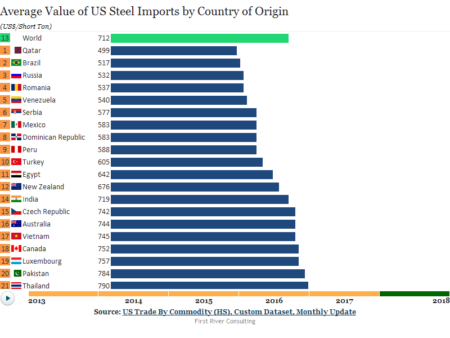
Another revealing dynamic ranking chart from the Steel Data Room shows you how the average value of US steel imports per ton have changed over time by country. Watch the dynamic version here or register to create you own. Includes carbon & alloy semi-finished, flat & long finished products only. No stainless, no pipe & tube.
Based on reported import licenses, US long products imports rose 30% from 336,000 short tons in March to 436,000 tons in April. This was mainly due to higher rebar imports from Turkey and higher parallel flange sections imports from Korea and Taiwan.
Long products imports in the first four months of 2018 were 28% lower than in the same period last year, led by a 35% drop in rebar imports and a 35% fall in wire rod imports.
SIMA US long products import licenses
2012 to 2018
short tons
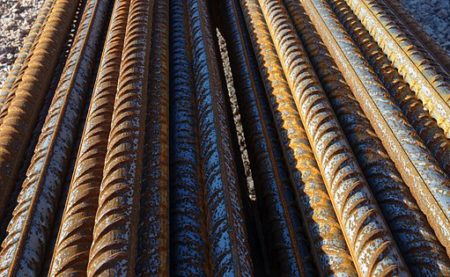
Photo by W.carter [CC BY-SA 4.0 (https://creativecommons.org/licenses/by-sa/4.0)], from Wikimedia Commons
This dynamic ranking chart shows you how China grew from the world’s third largest steel producer in 1992 to number one in 1996 and beyond. And how India rose from number ten in 1992 to number three in 2016.
Register for free in the Steel Data Room, and you can quickly set up dynamic charts like this one, where a click on the Play button will illustrate how the steel world has changed over the last 25 years.


